
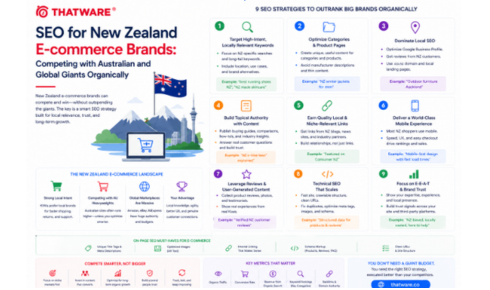
New Zealand’s e-commerce market has a fundamental structural challenge that every NZ online retailer eventually has to reckon with: most of the credible, well-funded competition for the search queries that matter isn’t from other New Zealand businesses — it’s from Australian e-commerce brands and global giants who rank in the NZ Google results without having invested specifically in the NZ market.
This is both the challenge and the opportunity. Australian brands rank in NZ search because of their domain authority, not because they’ve built NZ-specific content or optimised specifically for NZ search behaviour. That gap — the space between what the large players do and what genuinely NZ-specific, locally-relevant content would do — is where smart NZ e-commerce brands can build meaningful organic visibility.
Understanding the Competitive Landscape
When you run competitive analysis for most product categories in Google New Zealand, you’ll find a predictable pattern. The top few organic positions are occupied by Australian marketplaces and global platforms — Catch, ASOS, Amazon (where relevant), and category-specific large players. Beneath them, a mix of NZ-specific and Australian brands compete for the remaining positions.
The authority advantage of large Australian and global players in NZ search is real. It doesn’t disappear. But it has limits that a well-executed NZ-specific SEO strategy can exploit.
Large platforms optimise for broad category terms. They don’t build content specifically addressing NZ buyer concerns — GST implications, NZ-specific product standards, shipping timelines to NZ locations, availability through NZ payment methods. They don’t create content calibrated to NZ seasonal patterns (summer in December, ski season considerations, NZ public holiday shopping patterns). And they typically don’t earn links from NZ media properties — Stuff, NZ Herald, Newshub, regional outlets — that carry specifically NZ-relevant authority signals.
Each of these gaps is an opportunity for NZ e-commerce brands with the strategic focus to exploit them.
The NZ-Specific Content Advantage
The content strategy that produces the strongest sustainable organic advantage for NZ e-commerce brands is one that builds genuine topical authority in a specific product category from an explicitly NZ perspective.
This means content that addresses NZ-specific buyer considerations — not just generic product information that could have been written anywhere. For outdoor gear retailers: content about specific NZ tramping tracks, Department of Conservation requirements, NZ weather patterns that affect gear selection. For homewares retailers: content referencing NZ design trends, NZ craftspeople and suppliers, NZ interior design contexts. For pet food brands: NZ-specific regulatory information, NZ vet recommendations, NZ pet lifestyle contexts.
This kind of content can’t be produced by an Australian brand or a global platform at scale — the specific NZ knowledge required makes it genuinely difficult to replicate without actual NZ expertise. That’s what makes it a sustainable competitive moat rather than a temporary advantage.
Seo services new zealand that include this kind of NZ-specific content strategy development — understanding which NZ-specific angles create genuine competitive advantage in each category — produce meaningfully better results than generic content programmes applied to a NZ domain.
The Trans-Tasman SEO Question
Many NZ e-commerce brands also sell into Australia, or aspire to. The international SEO question — how to optimise for both markets — is worth addressing specifically.
Separate hreflang implementation for .co.nz and .com.au domains (or NZ and AU subdirectories on a single domain) is the technical foundation. Without this, Google can serve NZ-optimised content to Australian searchers or vice versa, reducing effectiveness in both markets.
Content strategy should be genuinely market-specific rather than applying a “global English” approach. The terminology differences between NZ and Australian English, the regulatory differences, and the market-specific buyer concerns are real enough that attempting to serve both markets with identical content produces inferior results in both.
Link building for the Australian market requires Australian editorial relationships, which are separate from NZ relationships. The investment to build meaningful authority in both markets is substantial enough that most NZ brands should focus on dominating NZ organic search first, then expanding Australian investment as resources allow.
Technical Considerations for NZ E-commerce
Hosting and CDN geography matters for NZ e-commerce brands even more than for Australian ones, because NZ’s distance from global infrastructure creates more significant latency without local edge caching.
New Zealand-optimised CDN configurations — prioritising Asia-Pacific edge nodes, particularly Australian points of presence — can meaningfully reduce page load times for NZ users. Core Web Vitals improvements from faster load times directly support rankings and produce measurable conversion rate improvements.
The NZ e-commerce platform landscape is dominated by Shopify, with WooCommerce having significant presence. Both platforms have NZ-specific considerations around GST configuration, NZ payment gateway integration, and NZ-specific shipping configuration — all of which can create technical SEO issues if not properly implemented.
Building NZ-Specific Authority Through Links
The NZ media and publishing landscape is smaller but coherent, and earning links from NZ-specific authoritative sources produces genuine local authority signals.
Stuff.co.nz, NZHerald.co.nz, and Newshub carry strong domain authority and are genuinely achievable for NZ brands with real news to share — product launches, sustainability initiatives, local economic impact stories, genuinely interesting founder narratives.
Beneath the nationals, vertical NZ media — NZ retail industry publications, sector-specific NZ publications, NZ business media — are more accessible and their links carry contextually specific relevance for NZ e-commerce operations.
The NZ business community is highly networked and relationship-driven in ways that make organic partnership and collaboration link building more effective than cold outreach. Industry associations, Business NZ, regional chambers of commerce, and vertical industry bodies all represent link opportunities through genuine participation rather than transactional link acquisition.
Seo company new zealand operations with genuine NZ editorial relationships and NZ market expertise produce link profiles that are both more achievable for NZ brands and more effective in NZ search than internationally-focused link building approaches applied to NZ domains.
The Realistic Path Forward
For most NZ e-commerce brands, the organic search opportunity is genuinely significant and genuinely accessible with appropriate strategy and sustained investment.
The brands that are winning NZ organic search right now are the ones that focused specifically on the NZ market opportunity — building NZ-specific content depth, earning NZ editorial links, and optimising technically for NZ user performance — rather than trying to compete globally from the start.
That focused, market-specific approach is available to brands starting today. The window is open. The question is whether you’re willing to invest the time and resource to walk through it.